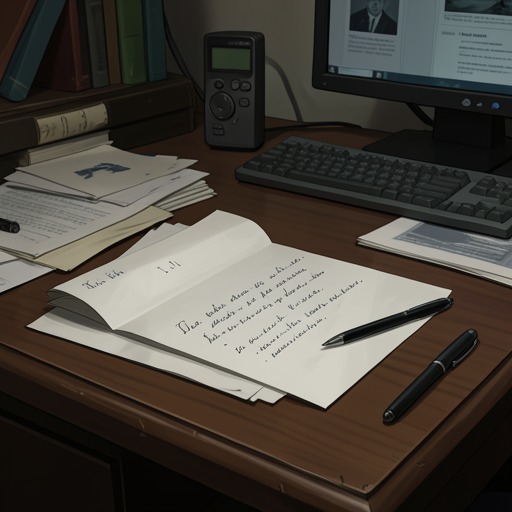
Tooru reminder note
Even If This Love Disappears From the World TonightThe Tooru reminder note is a message Maori Hino left for her future self during her anterograde amnesia, urging her to remember Tooru Kamiya even if she recovered. Hidden on the back of a memory note, it links written records to a physical hiding place and becomes a clue through which Maori later understands that her drawings of Tooru were deliberately kept safe. Its importance lies in the message’s double purpose: it preserves a name across memory loss and directs Maori toward evidence of the love her records no longer explain.
Discovery and Wording
While replacing Maori’s handwritten notes with typed copies, Izumi Wataya found a sticky note attached to the back of one sheet. Reading it, she froze. The message read: “Even if I recover, always remember Tooru Kamiya. The important things will always be in an important place.” The wording addresses a future Maori whose memory may have returned, but whose knowledge of Tooru might not. It is not merely a prompt to reconstruct daily events; it names a person she could otherwise lose from her account of herself.
The note’s position mattered as much as its words. Izumi reasoned that Maori had attached it to the reverse side so that she would see it when she took the sheet down—in other words, after recovering from amnesia. The message thus appears designed to survive the routine it interrupts: it is concealed during ordinary use, yet positioned to be discovered at a moment when Maori’s relationship to her records has changed. Izumi could not know whether Maori had anticipated what she and Tooru’s sister were doing or whether the note was simply an expression of Maori’s feelings. She kept it rather than discarding it, reattaching it to the replacement sheet so Maori might eventually find it.
The Records It Interrupts
The note surfaced amid an effort to remove Tooru from Maori’s records after his death. Izumi and Tooru’s sister planned to revise Maori’s binder and journal, including digital copies, because Maori had recovered from amnesia but remained at risk of depression. Tooru’s sister offered to type the records into a computer and repair the passages where his presence had been removed. The intention was not simply to delete a name from a page: every trace in photographs, videos, messages, and written entries had to be considered, and the altered material was meant to let Maori continue reading about her daily life without discovering the loss through an accidental reference.
On the morning of the third day after Tooru’s funeral, Izumi entered Maori’s room while she was still sleeping in her parents’ room. She gathered the binder and volumes of the journal, transferred the revised digital material to Maori’s laptop, and used altered timestamps so the files would appear consistent. Maori would henceforth read the digitized notes and journal and add new entries there. Izumi also replaced Maori’s phone and arranged for her parents to explain that the old one had broken; the messaging history would be obscured as a failed data transfer. In this coordinated editing of the record, the little note was an exception: a fragment Izumi chose to preserve rather than neutralize.
The Important Place
The note’s second sentence initially sounded to Izumi like a general reassurance. Its meaning sharpened only after Maori later found a sketchbook behind her bookcase. When Maori explained that she had hidden things there as a child, Izumi remembered the message and understood that “an important place” was not metaphorical. The hidden location contained drawings of Tooru, evidence that Maori had intentionally put something of importance out of sight and left it for a future self to recover.
That discovery changes the note from an isolated declaration into a set of directions. The message does not identify the bookcase or describe the sketches, but its insistence on an important place lets Izumi connect the hiding place to Tooru. Maori herself wondered why the drawings were absent from her diary and why she had concealed them. Her childhood practice of hiding private things behind the bookcase gave the rediscovered sketchbook a personal history; the note, preserved on paper, supplied a link between that old habit and her later effort to remember Tooru.
Preservation and Aftermath
Izumi kept the sticky note attached to the replacement sheet because she thought Maori might discover it eventually. At the same time, she placed the typed sheets on the wall, where the altered, lifeless pages stood in contrast to the handwritten note. The contrast makes the note’s material survival consequential: while the records around it were being copied, edited, and reorganized, this small piece of paper retained a message in Maori’s own words and a clue to what the edited account omitted.
The note did not immediately restore Maori’s memories. After recovery, she initially forgot Tooru, and Izumi concealed the truth, describing him as someone Maori had seen at the library during summer break. Years later, Maori was still trying to remember him, using her journal and Izumi’s stories to revisit places and experiences. The note’s message had been preserved, but its meaning depended on a later encounter with the sketchbook and on Maori’s continuing search. Its role is therefore both intimate and indirect: it cannot itself bring back a shared past, but it helps keep open a route toward one.
Memory, Love, and the Future Self
Maori eventually chose to seek the memories she had lost, despite the possibility that remembering Tooru would hurt. She feared that seeing photographs and videos might replace her own uncertain image of him with the images in the recordings, but agreed to listen to audio Izumi extracted from a video. The sound of a bicycle ride, wind, and her own delighted voice brought back the circumstance of the recording. That recovery through sound parallels the note’s reliance on an object: neither presents the whole relationship at once, but each offers a specific point of access to what Maori could not retrieve by intention alone.
The note’s promise that important things remain in important places also resonates with Maori’s later recovery through drawing. She eventually made portraits of Tooru as she remembered him, and described the memories as sleeping in her body and heart. Her drawings did not erase the fact of his death or the pain of loss; they allowed remembrance to become a continuing bond rather than a demand to remain captive to the past. The note anticipates that distinction: it asks Maori not to lose Tooru, while the later conversation with his sister also asks her to keep living and to love again when she can.
Three years after Maori vowed that she would remember, she was still trying. She had revisited places and experiences without an easy or immediate result, but little by little recalled Tooru. At the cherry-blossom park, Izumi saw drawings of him that she had never encountered before—portraits of Tooru as Maori remembered him. The note’s instruction had never guaranteed that memory would return intact. Instead, it preserved a claim from one version of Maori to another: that Tooru mattered, that the evidence of him might be hidden somewhere she once knew, and that forgetting did not have to be the final account of her life.